Lifecycle & Circular HVAC Solutions for Industrial Facilities
August 13, 2026
VRF & Modular HVAC Systems for Scalable Industrial and Commercial Spaces
August 25, 2026
The UK’s increasingly extreme summers are forcing an uncomfortable question for healthcare estates teams:
Are NHS buildings equipped to keep patients, staff and critical services safe when temperatures rise?
This summer has provided some stark evidence that the answer is not always yes.
In June, hospitals across England experienced serious disruption during extreme heat, with reports of cooling systems failing, IT and medical equipment being affected, and temperatures on some wards reaching levels that doctors described as unsafe.
Last week, the Royal College of Nursing went further, warning that nursing staff were collapsing at work in extreme heat and calling for urgent improvements including better ventilation and air conditioning.
Today’s reporting continues to highlight the pressure that extreme temperatures are placing on patients, staff and NHS infrastructure.
These stories should not simply be viewed as a response to one unusually hot summer.
They should be seen as a warning about the resilience of healthcare buildings.

Hospitals are not ordinary buildings
A hospital or healthcare facility has a fundamentally different set of HVAC requirements from a typical office.
Temperature and air quality can directly affect:
- Patient comfort
- Staff wellbeing
- Infection control
- Clinical environments
- Medication storage
- Specialist equipment
- IT infrastructure
- Operating conditions
- Patient recovery
At the same time, healthcare environments often operate continuously, making planned maintenance and system reliability particularly important.
There is also a fundamental engineering challenge.
You cannot simply treat ventilation and cooling as separate issues.
They need to work together.
Why opening windows isn’t enough
Natural ventilation can be useful in the right circumstances, but healthcare environments often require much greater control over airflow and environmental conditions.
Opening a window does not allow a facilities team to precisely control:
- Airflow rates
- Temperature
- Humidity
- Filtration
- Air distribution
- Pressure relationships
- Air changes
- Contaminant control
And in a hospital, external conditions are constantly changing.
A window may provide fresh air, but if the outdoor temperature is 30°C or more, it isn’t necessarily going to make the room cooler.
There are also situations where uncontrolled airflow simply isn’t appropriate.
This is why healthcare HVAC design requires a much more considered approach.
Ventilation and cooling need to be designed together
Good ventilation is about bringing fresh air into a building and removing stale or contaminated air.
Cooling is about managing temperature and thermal comfort.
The two systems can work together, but the solution needs to be designed around the specific environment.
For example, an NHS building might require:
-
Cooling
To maintain suitable temperatures in areas vulnerable to overheating. -
Filtration
Where the environment and application require controlled air quality. -
Controls
To ensure systems respond appropriately to occupancy and changing conditions. -
Heat Recovery
Where appropriate, to improve energy efficiency. -
Maintenance
To keep systems operating reliably when they are needed most.
This integrated approach is particularly important when upgrading existing healthcare buildings.
Retrofitting healthcare buildings is not straightforward
One of the biggest challenges facing NHS estates teams is that many healthcare buildings were constructed long before today’s climate conditions were anticipated.
Adding modern HVAC infrastructure can involve working around:
- Occupied clinical environments
- Existing ductwork
- Electrical capacity
- Restricted plant space
- Complex building layouts
- Infection-control requirements
- Access constraints
- Critical clinical services
- Legacy equipment
That makes early planning essential.
A cooling system that works perfectly in a new-build environment may not be the appropriate answer for an existing hospital.
The engineering solution has to fit the building.
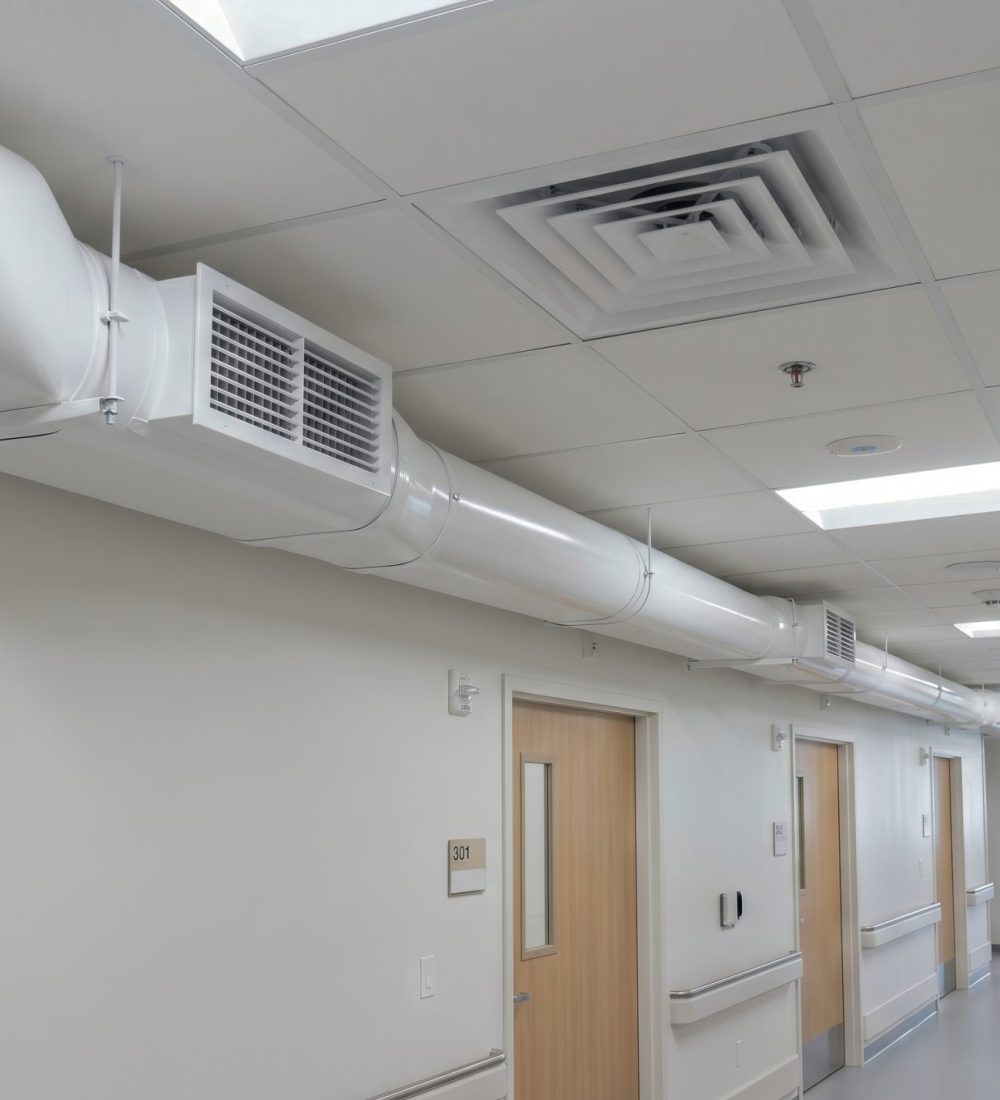
Reliability matters as much as capacity
One of the clearest lessons from this summer is that having an HVAC system isn’t necessarily the same as having a resilient HVAC system.
Extreme heat places additional demand on equipment.
Systems may operate for longer periods and at higher loads. Components that are already ageing or poorly maintained can become more vulnerable.
This is why preventative maintenance is so important.
Regular inspection and servicing can identify issues before they become failures, while condition assessments can help estates teams prioritise capital investment.
For a healthcare facility, that isn’t simply about comfort.
It is about operational resilience.
Summer resilience should become part of estates planning
For years, healthcare estates planning has understandably focused heavily on winter pressures.
But the operating environment is changing.
The UK Government’s recent work on climate adaptation recognises that the country needs to prepare for the impacts of a changing climate, including the infrastructure challenges exposed by extreme heat.
For NHS estates teams, that means summer resilience needs to become part of longer-term planning rather than something addressed only when a heatwave is forecast.
The questions should include:
- Which areas of the estate are most vulnerable to overheating?
- Which HVAC systems are approaching the end of their serviceable life?
- Where is ventilation inadequate?
- Where is additional cooling required?
- Can existing systems be upgraded?
- What happens if a critical cooling system fails?
- Are maintenance regimes appropriate for increased summer demand?
- What capital investment should be planned before the next extreme event?

The goal isn’t simply to install more air conditioning
This is an important distinction.
The solution to overheating in healthcare should not be reduced to:
“Install more air conditioning.”
The better question is:
“How do we create a healthcare environment that can manage temperature, air quality, energy use and operational demands reliably?”
Sometimes that will mean air conditioning.
Sometimes it will mean mechanical ventilation.
Sometimes it will involve upgrading controls, improving heat recovery or replacing ageing equipment.
And in many cases, the answer will be a combination of technologies.
The time to plan is before the next heatwave
The NHS cannot afford to wait until temperatures are already climbing to discover which parts of its estate are vulnerable.
A planned HVAC assessment can provide a clearer picture of the current condition of systems, identify areas of concern and help estates teams develop a prioritised improvement programme.
At Inergy Group, we work across healthcare and other critical environments, designing, installing and maintaining ventilation and HVAC systems with a focus on safe, comfortable and energy-efficient buildings.
The challenge isn’t simply keeping buildings cool.
It’s making them resilient enough to cope with the conditions we now know are coming.
Is your healthcare estate ready for the next heatwave?
This summer has demonstrated that overheating is no longer just a comfort issue.
For healthcare buildings, it can become an operational, safety and infrastructure issue.
The next heatwave will arrive. The question is whether the building will be ready for it.